Common Convention Hotel Networking Mistakes: The Editorial Guide
The professional convention serves as a pressurized environment for social and economic exchange, where the physical layout of the hotel becomes the silent architect of interpersonal success. While many attendees focus on the scheduled content of the plenary sessions, the true value of these gatherings often resides in the interstitial spaces—the hotel lobby, the elevator banks, and the satellite lounges. However, navigating these spaces effectively requires a level of social intelligence that is frequently underestimated. The ability to transition from a transient guest to a high-value networker is a skill that demands both spatial awareness and psychological precision.
The complexity of networking in a convention hotel stems from the “Liminal Paradox”: participants are simultaneously in a place of business and a place of rest. This blurring of boundaries creates a unique set of behavioral risks. Actions that are acceptable in a standard office environment may feel intrusive in a hotel bar, while the casual nature of a poolside lounge can lead to an unprofessional relaxation of standards. To master this environment, one must treat the hotel not as a backdrop, but as a strategic asset with its own set of unwritten rules and operational triggers.
Furthermore, the shift toward hyper-connectivity has introduced a new layer of friction. The prevalence of digital distractions often creates a “social insulation” that prevents the spontaneous serendipity that trade shows are designed to foster. Identifying and correcting the habits that lead to missed opportunities is essential for anyone seeking a return on their significant investment of time and capital. This article serves as a definitive reference for those looking to move beyond the surface-level “meet and greet” to a more sophisticated, high-authority approach to professional relationship building.
Understanding “common convention hotel networking mistakes”
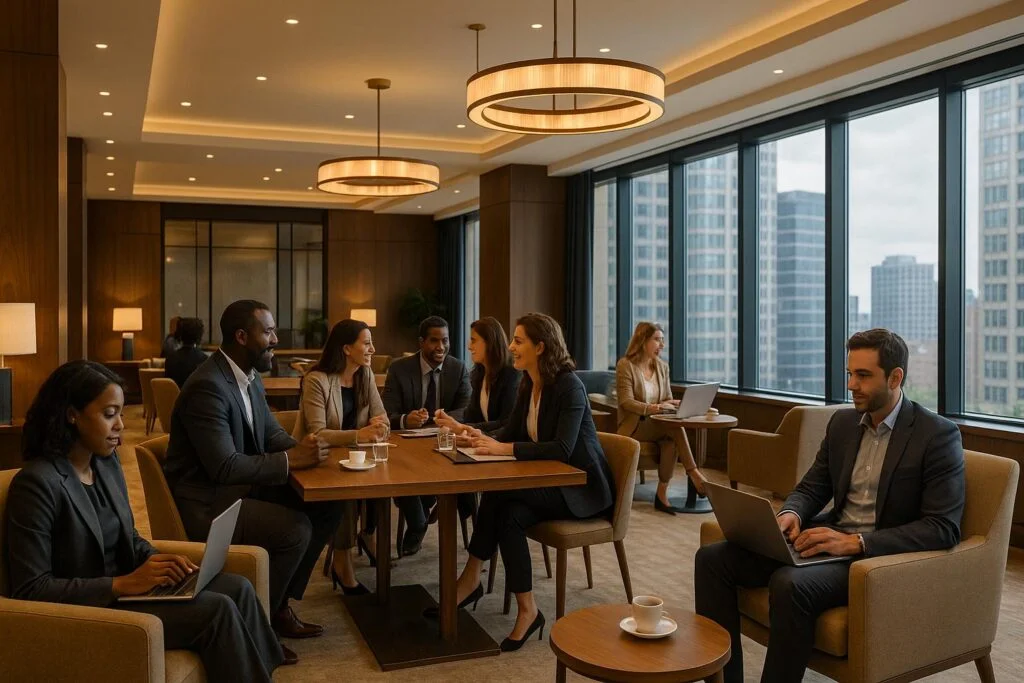
To effectively analyze common convention hotel networking mistakes, one must view the hotel through multiple lenses: as a marketplace, a private residence, and a public square. A common misunderstanding among attendees is the belief that networking is an “always-on” activity. This “Volume-First” approach often leads to “Networking Fatigue,” where the quality of interactions degrades in favor of a high quantity of shallow exchanges. The risk here is the “Dilution of Authority”—when a participant is seen everywhere but engaged nowhere deeply, they lose their perceived expertise.
Oversimplification in this domain often manifests in the “Pitch-First” mentality. Many participants treat the hotel lobby like a sales floor, failing to recognize that the hotel environment is naturally geared toward the building of rapport rather than the closing of deals. A sophisticated networker understands that the lobby is for “Contextual Intelligence”—gathering information about a prospect’s challenges and personality—while the formal meeting room is for the transaction. Forgetting this distinction is a primary cause of social friction that can alienate high-value contacts before a formal relationship is even established.
Another critical perspective involves “Spatial Ignorance.” A hotel has different “energy zones.” The front desk area is high-friction and logistical; the coffee shop is high-flow and transient; the bar is low-friction and stationary. A major mistake is attempting a high-depth conversation in a high-flow zone. This lack of situational awareness forces the contact to constantly look over their shoulder or worry about their next transit, preventing the psychological “sinking-in” required for a meaningful professional bond.
The Historical Shift from Transactional to Relational Networking
The history of convention networking mirrors the evolution of the American middle class and the corporate structure. In the early 20th century, conventions were primarily about the distribution of physical goods. Networking was “Transactional”—it was about the handshake that sealed a shipment of steel or textiles. The hotel was merely a dorm where the “boys” would retreat after the day’s business was done.
The 1970s saw the birth of the “Knowledge Economy,” which shifted the focus from goods to expertise. The hotel became a “Think Tank.” Networking began to move into the hospitality suites, where the “power lunch” and the “cocktail hour” became the primary vehicles for influence. During this era, the “gatekeeper” model was dominant; you networked to get past a secretary or a junior associate.
Today, we are in the era of Democratized Serendipity. In a world of LinkedIn and instant connectivity, the “gatekeeper” has been bypassed. However, this has led to a saturation of noise. The modern mistake is not a lack of access, but a lack of presence. Because we can connect with anyone, we often fail to connect with the person standing next to us in the elevator line. The historical arc has moved from “Access” to “Attentiveness,” yet the fundamental need for human-to-human trust remains the bedrock of the industry.
Conceptual Frameworks: The Physics of Social Exchange
To avoid common errors, one should apply specific mental models that account for the variability of human interaction.
1. The “Social Dividend” Framework
View every interaction as a deposit or a withdrawal from your “Relational Capital.” A mistake—such as interrupting a conversation or forgetting a name—is a withdrawal. A value-add—such as a relevant introduction or a thoughtful insight—is a deposit. The goal is to leave the convention with a higher “Dividend” than you started with, regardless of how many business cards you collected.
2. The “Anchor vs. Satellite” Model
In any networking environment, there are “Anchors” (people everyone wants to meet) and “Satellites” (everyone else). A common mistake is for Satellites to crowd the Anchors, creating a low-value “mosh pit” effect. The sophisticated strategy is to network with the other Satellites around an Anchor; these are often the people who will actually become your partners and collaborators.
3. The “Propinquity Effect”
This psychological principle states that people tend to form relationships with those they encounter most frequently. A major mistake is “One-and-Done” networking—meeting someone once and never following up. To leverage the Propinquity Effect, you must strategically “cross paths” with a contact 2–3 times over the course of the three-day convention (the elevator, the breakfast line, the evening bar) to solidify the sense of familiarity.
Key Categories of Networking Failures and Trade-offs
Networking mistakes generally fall into several operational categories, each with distinct consequences.
| Category | Typical Mistake | Strategic Trade-off | Resulting Failure |
| Logistical | Camping in the hotel room | Comfort vs. Opportunity | Invisible Presence |
| Tactical | “Badge-Hunting” (looking past current speaker) | Speed vs. Depth | Perceived Disrespect |
| Spatial | Cornering a contact near the restroom | Convenience vs. Dignity | Psychological Discomfort |
| Digital | Excessive phone usage in lounges | Connectivity vs. Availability | The “Social Shield” |
| Nutritional | Over-indulging in the open bar | Relaxation vs. Reputation | Loss of Professional Authority |
| Follow-up | Collecting cards without a CRM plan | Action vs. Memory | The “Dead-End” Contact |
Decision Logic: The “Lobby-to-Lounge” Pivot
The “Lobby” is for initial identification. The “Lounge” is for the 15-minute qualification. The “Hotel Restaurant” is for the 60-minute deep dive. A primary mistake is trying to perform a 60-minute deep dive in the middle of a high-traffic lobby.
Detailed Real-World Scenarios
Scenario 1: The “Elevator Pitch” Overreach
An attendee recognizes a key CEO in the hotel elevator.
-
The Mistake: They launch into a 3-minute business pitch during a 20-second ride.
-
The Analysis: The CEO feels trapped in a small, enclosed space, creating an immediate defensive reaction.
-
The Corrective Action: A simple, high-authority acknowledgement—”I enjoyed your keynote earlier, I’m [Name] with [Company]”—followed by a respectful exit. This builds the “Propinquity” for a later, more natural meeting.
Scenario 2: The “Cluster” Error
A team of four colleagues from the same company stands in a tight circle in the center of the hotel’s networking reception.
-
The Mistake: “Internal Networking.”
-
The Analysis: A closed circle is physically and psychologically impenetrable to outsiders. The team is essentially paying thousands of dollars to talk to the same people they see every Tuesday.
-
Second-Order Effect: They miss the “Satellite” contacts who were looking for an opening but were intimidated by the group’s closed body language.
Planning, Cost, and Resource Dynamics
The “Investment” in convention networking involves more than just the registration fee.
Range-Based Resource Allocation Table
| Resource Type | Baseline Expense | Opportunity Cost | Strategic Lever |
| The “Bar Tab” Budget | $200 – $500 | Lost evening “Deep Work” | Selecting the “Right” drinks (quality > quantity) |
| Room Selection | Standard | High (No “Meeting Space”) | Booking a suite for private “Off-sites” |
| Time Management | 100% attendance | Missed “Hallway Track” | Skipping 1 session for 1 high-value intro |
| Wardrobe/Appearance | Casual | Loss of “Visual Authority” | Balancing “Convention Casual” with brand |
Indirect Costs include “Social Burnout.” If you over-plan your networking—booking every breakfast, lunch, and dinner—you will lose the mental acuity needed to actually be interesting by day three.
Tools, Strategies, and Support Systems
A high-authority networker uses a “Stack” of support systems:
-
Digital Business Cards: Tools like Blinq or HiHello that allow for instant, contact-free exchange without the “Card-Fumble” mistake.
-
The “Pre-Event” LinkedIn Audit: Researching the “Anchors” of the convention to identify common interests before arriving at the hotel.
-
CRM Integration: A system for tagging contacts by the location they were met (e.g., “Mandalay Bay Lobby Bar”) to add context to the follow-up.
-
The “Buffer Hour”: Scheduling 60 minutes of “alone time” in the hotel room between the sessions and the evening social to recharge the “Extrovert Battery.”
-
Introduction Etiquette: The “Double Opt-in” intro—asking both parties before connecting them—to avoid being the “Introduction Spammer.”
-
The “Exit Strategy”: A polite, pre-planned phrase to end a low-value conversation without causing offense.
The Risk Landscape: Compounding Social Failures
Risk in a hotel environment is often cumulative. A single mistake might be forgiven, but a pattern of behavior creates a “Brand Narrative.”
-
The “Transactional” Label: If you are known as the person who only talks to people who can “do something” for you, the Anchors will eventually block you.
-
The “Privacy Breach”: Mentioning a sensitive business detail overheard in the hotel gym or elevator. The hotel environment “feels” private, but it is a “Shared Acoustic Space.”
-
The “Reputational Shadow”: Professional behavior is required from the moment you step off the plane to the moment you check out. A late-night incident in the hotel bar is often the only thing people remember about your 3,000-word presentation earlier that day.
Governance and Long-Term Relationship Adaptation
Networking doesn’t end when the hotel bill is paid.
-
The “48-Hour” Rule: Follow-ups must happen within 48 hours, but they should be “Low-Pressure.” A mistake is asking for a meeting in the first follow-up; the goal of the first email is to simply “Anchor the Memory.”
-
Layered Follow-up Checklist:
-
[ ] Connect on LinkedIn with a personalized note mentioning the hotel/event.
-
[ ] Send the specific resource or link you promised during the conversation.
-
[ ] Tag the contact in your internal CRM with the “Hotel Context.”
-
[ ] Set a “3-Month” reminder to check in again when the “Convention High” has faded.
-
Measurement, Tracking, and Evaluation
How do you measure a “Social Asset”?
-
Leading Indicator: “The Introduction Ratio.” How many people did you introduce to each other? This measures your “Node Value” in the network.
-
Lagging Indicator: “The 6-Month Conversion.” How many hotel lobby conversations turned into a formal discovery call or partnership within half a year?
-
Qualitative Signal: “Unsolicited Outreach.” The number of people who sought you out because of your presence in the hotel’s public spaces.
Common Misconceptions and Oversimplifications
-
“You have to be an extrovert to network.” Correction: Introverts often make better networkers because they listen more than they talk, avoiding the “Talking-at-People” mistake.
-
“The bar is where the real business happens.” Correction: The bar is where the affinity happens; the business happens in the follow-up.
-
“Always be closing.” Correction: In a hotel setting, “Always be Connecting” is a more resilient strategy.
-
“Collecting 100 cards is a win.” Correction: Collecting 5 deep connections is a win; 100 cards is just a data entry problem.
-
“People will remember me.” Correction: They won’t. You are one of 5,000 faces they saw that week. You must provide a “Contextual Hook.”
-
“I’m off the clock in the hotel.” Correction: You are a representative of your brand until you are behind your own locked hotel room door.
-
“Badge Ribbons define status.” Correction: Some of the most influential people at a convention intentionally wear “Plain” badges to avoid being swamped by “Badge-Hunters.”
-
“Social media is a substitute for the lobby.” Correction: Digital is the “Map,” the hotel lobby is the “Terrain.” You cannot build the same level of oxytocin-driven trust through a screen.
Ethical and Practical Considerations
In a modern context, networking must also account for Inclusivity and Safety. A common mistake is selecting “Exclusive” networking environments—such as high-end cigar bars or late-night clubs—that may exclude or make certain demographics feel unwelcome. A sophisticated networker chooses “Neutral Ground”—well-lit hotel lounges or coffee shops—that facilitate comfortable interaction for all participants. Practically, this also includes “Digital Etiquette”—not taking photos or videos of others in the hotel’s social spaces without permission, respecting the “Liminal” nature of the hotel as a temporary home.
Synthesis and Editorial Conclusion
The avoidance of common convention hotel networking mistakes is ultimately an exercise in “Intentional Presence.” It is the refusal to allow the logistical friction of travel to degrade the quality of human interaction. The hotel is not a vacuum; it is a high-density theater where your professional character is on display in every hallway and elevator bank.
By moving from a transactional mindset to a relational one—and by treating the hotel’s spatial dynamics with the respect they deserve—the attendee can transform a standard business trip into a landmark career event. The most successful networkers are those who understand that while the hotel provides the rooms, the attendees provide the value. In the complex world of modern industry, the most powerful tool you possess is not your slide deck or your product demo, but your ability to navigate a crowded lobby with grace, intelligence, and a genuine interest in the person standing in front of you.